
𝗪𝗵𝘆 𝗜 𝗗𝗲𝘃𝗲𝗹𝗼𝗽𝗲𝗱 𝘁𝗵𝗲 𝗦𝗣𝗔𝗗𝗘𝗦™ 𝗙𝗿𝗮𝗺𝗲𝘄𝗼𝗿𝗸
Updated: Aug 17

Every great organization knows that people are its greatest competitive advantage.
Yet most organizations manage talent in pieces. Recruiting sits in one department. Learning lives somewhere else. Performance reviews become annual paperwork. Succession planning is often an emergency response instead of a long-term strategy.
People deserve better. Organizations deserve better.
That's why I developed the SPADES™ Framework—an integrated approach that views talent as a continuous journey rather than a collection of disconnected HR activities.
But why SPADES?
Because a spade is one of humanity's oldest and most important tools.
A spade doesn't create the harvest. It prepares the ground, so the harvest becomes possible. Before anything can grow, someone must break hard ground, remove obstacles, enrich the soil, and prepare the environment.
Leadership is no different. Our responsibility isn't to make people grow. Our responsibility is to create the conditions where growth becomes inevitable.
The symbolism runs even deeper.
A spade represents wisdom, labor, preparation, and transformation. It takes work to cultivate great people. Just as early metal spades made digging more effective than simple wooden tools, organizations must continually sharpen how they develop talent to increase capability, competence, and organizational performance.
Here's how the framework comes together.

S — Strategic HR Planning
"Thinking with the End in Mind."
Everything begins with strategy.
Too many organizations hire because someone resigned. High-performing organizations hire because they know where they're going.
Strategic HR Planning asks:
What capabilities will we need three to five years from now?
What leadership competencies will differentiate us?
What work should people perform versus technology?
Where are our capability gaps?
What culture are we intentionally building?
When strategy drives talent decisions, every role has purpose. Without strategy, every other talent initiative becomes reactive.

P — People Attraction
"The Laws of Attraction."
Recruiting isn't about filling vacancies. It's about attracting people who belong.
The best organizations recruit for more than technical skills. They recruit for:
Character
Values
Learning agility
Adaptability
Curiosity
Emotional intelligence
Leadership potential
Cultural contribution
Technical skills can often be taught. Character is much harder to develop.
Organizations that become Employers of Choice understand that attracting talent starts long before the job posting. It begins with reputation, culture, leadership, and purpose.

A — Advancing Through Development
"Equipping Competencies, Skills, and Behaviors."
This is where organizations either separate themselves or fall behind.
Development is not training. Training transfers knowledge. Development transforms capability. Great organizations intentionally move people through a progression:
Discover - Engage - Apply - Advance - Grow - Evolve
Every employee should have:
Individual Development Plans [IDPs]
Coaching conversations
Stretch assignments
Cross-functional experiences
Leadership opportunities
Continuous learning pathways
Knowledge creates awareness. Practice builds competence. Experience develops wisdom.
Organizations don't become learning organizations because they buy an LMS. They become learning organizations because leaders become teachers and coaches.

D — Driving Performance
"Measure Twice. Cut Once."
Performance management should never surprise people. It should guide them. Performance isn't simply measuring results. It's aligning:
Goals
Behaviors
Competencies
Values
Accountability
Growth
Great leaders ask:
"What helped you succeed?"
"What got in your way?"
"What should we build next?"
Performance conversations should create confidence, not fear. Measurement without coaching becomes judgment. Measurement with coaching becomes growth.

E — Elevating Through Succession
"Building the Bench."
The best time to prepare future leaders... is before you need them. Succession planning isn't replacing people. It's multiplying leadership.
Organizations should constantly identify:
Emerging leaders
Critical positions
Readiness levels
Development opportunities
Career aspirations
Strong succession planning protects culture. It protects customers. It protects organizational knowledge. Most importantly, it protects momentum.
Leadership should never depend upon one person.
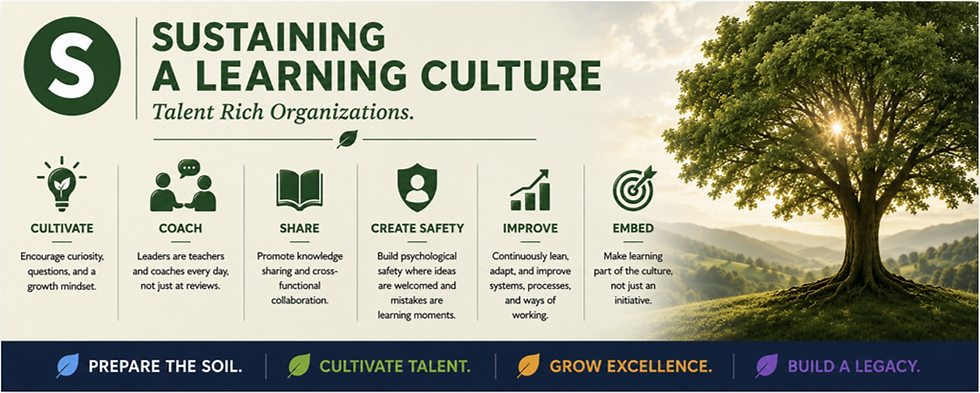
S — Sustaining a Learning Culture
"Talent Rich Organizations."
The final "S" is where everything comes together.
Learning cannot be an event. It must become an expectation. Talent-rich organizations encourage:
Curiosity
Experimentation
Coaching
Psychological safety
Knowledge sharing
Continuous improvement
The goal isn't simply creating a learning organization. It's becoming a knowledge-driven organization where learning, teaching, coaching, and training work together to continually increase both individual and organizational capability.
The Bottom Line
The organizations that will dominate the next decade won't necessarily have the best products. They'll have the best people. More importantly, they'll have the best systems for helping people become even better.
That's what SPADES™ is all about.
Preparing the soil. Growing extraordinary people. Building extraordinary organizations. Because when you grow people intentionally, everything else grows with them.
The Management Sherpa's Role in Talent Management
Since 2015, The Management Sherpa has partnered with organizations ranging from $5 million entrepreneurial businesses to global enterprises exceeding $15 billion in revenue, helping leaders build stronger cultures, stronger leadership, and stronger organizations.
Along the way, we've had the privilege of serving clients across manufacturing, food and beverage, quick service restaurants, healthcare, pharmaceuticals, higher education, nonprofits, engineering, professional services, retail, and dairy, with clients spanning five continents.
While every engagement is different, the mission has never changed:
We help organizations become more human while becoming more effective.
Over the years, our work has included:
Organizational Development strategy and organizational design
Leadership competency models and success profiles
Frontline leadership development
Sales leadership and new manager bootcamps
Executive coaching and leadership coaching
360-degree leadership assessments and individualized development plans
Talent acquisition and interview frameworks
Succession planning and leadership pipeline development
Learning management systems and scalable workforce development
Change management and organizational transformation
Psychological safety, trust, communication, and accountability initiatives
We've learned something important along the way. Organizations don't transform because they buy another assessment. They transform because leaders intentionally develop people.
Learn more: themanagementsherpa.com, Cincinnati, U.S. | London, U.K.
Contact us: info@themanagementsherpa.com, 1-513-828-9352 | +44 0203 929 2030


Comments